Quantitative quantum soundness for compiled nonlocal games and the sequential NPA hierarchy for completely positive maps

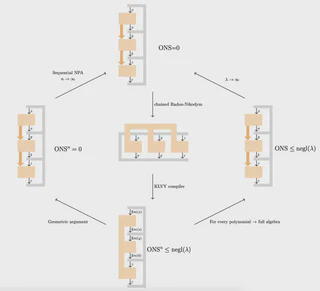 Image credit: Matilde Baroni
Abstract
Compiled nonlocal games transfer the power of Bell-type multi-prover tests into a single-device setting by replacing spatial separation with cryptography. Concretely, the KLVY compiler (STOC'23) maps any multi-prover game to an interactive single-prover protocol, using quantum homomorphic encryption. A crucial security property of such compilers is quantum soundness, which ensures that a dishonest quantum prover cannot exceed the original game’s quantum value. For practical cryptographic implementations, this soundness must be quantitative, providing concrete bounds rather than merely asymptotic. While quantitative quantum soundness has been established for the KLVY compiler in the bipartite case, it has only been shown asymptotically for multipartite games. This is a significant gap, as multipartite nonlocality exhibits phenomena with no bipartite analogue, and the difficulty of enforcing space-like separation makes single-device compilation especially compelling. This work closes this gap by showing the quantitative quantum soundness of the KLVY compiler for all multipartite nonlocal games. On the way, we introduce an NPA-like hierarchy for quantum instruments and prove its completeness, thereby characterizing correlations from operationally-non-signaling sequential strategies. This NPA-like hierarchy can be seen to complement previous multipartite generalizations of the S-G-HJW purification theorem, which takes a central role in quantum information, nonlocality, and contextuality. We further develop novel geometric arguments for the decomposition of sequential strategies into their signaling and non-signaling parts, which might be of independent interest.
The multipartite result (arXiv:2509.25145) generalizes and subsumes the earlier bipartite analysis. Talks given before 2025 correspond to the bipartite case, while later talks include the full multipartite framework. This talk has been presented at multiple venues. The date above is set to the most recent instance for correct ordering in the Talks list. Materials (slides/poster) are partially shared with twists
Talks
| Date | Event | Host / Location | Type |
|---|---|---|---|
| 2026-06 | SIAM Conference on Optimization (OP26)1 | Edinbrugh, United Kingdom | Invited |
| 2026-01 | QIP 20262 - 2 talks | Riga, Lativia | Contributed |
| 2025-12 | Quantum Meets3 | Online | Invited |
| 2025-11 | 3rd Colloquium GDR TeQ4 | Grenoble, France | Contributed |
| 2025-09 | YQIS255 | Barcelona, Spain | Contributed |
| 2025-07 | IWOTA 20256 | Twente, Netherland | Invited |
| 2025-06 | IQC-PCQT-Quantum Saclay Workshop7 | Paris, France | Invited |
Also presented at various internal group meetings during research visits.

Image credit: My wonderful colleagues

Image credit: IWOTA 2025 at Twente, Netherland
