Fermions are fundamentally more nonlocal than Bosons
2026-06-11·
Fatemeh Moradi Kalarde*,
Sadra Boreiri,
Xiangling Xu,
Lucas Tendick,
Salman Beigi,
Paolo Perinotti,
Tommaso Guaita,
Marc-Olivier Renou
arXiv:2606.12363 (2026)Talks at MTNS 2026
arXiv
Slides
Poster
BibTeX
@misc{kalarde2026fermionsfundamentallynonlocalbosons,
  title = {Fermions are fundamentally more nonlocal than Bosons},
  author = {Moradi Kalarde, Fatemeh and Boreiri, Sadra and Xu, Xiangling and Tendick, Lucas and Beigi, Salman and Perinotti, Paolo and Guaita, Tommaso and Renou, Marc-Olivier},
  year = {2026},
  date = {2026-06},
  eprint = {2606.12363},
  archiveprefix = {arXiv},
  primaryclass = {quant-ph},
  url = {https://arxiv.org/abs/2606.12363},
}
Abstract
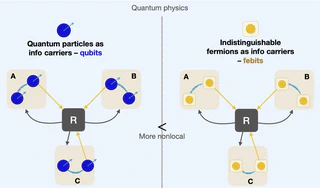
Bell’s theorem shows that entangled quantum particles can exhibit correlations that classical particles cannot reproduce without an additional nonlocal resource, such as communication. In this sense, quantum particles are fundamentally more nonlocal than classical ones, and entanglement becomes unavoidable in physics. Here we prove the analogous result within quantum theory itself: indistinguishable fermions transmitted through a quantum network can generate correlations that distinguishable particles or indistinguishable bosons cannot reproduce without additional communication. In the same sense, fermions are fundamentally more nonlocal than bosons or distinguishable particles, motivating fermionic anticommutation and indistinguishability as unavoidable operational resources. Our result further implies that fermions can strictly surpass all qubit-based protocols for certain distributed computing tasks, demonstrating that a complete understanding of information processing requires going beyond qubits to fermionic information carriers – febits.
Talks and posters
- International Symposium on Mathematical Theory of Networks and Systems (MTNS 2026) (by Fatemeh Moradi Kalarde)
- CQCC & GQSF 2026 (poster)
Corresponding author.